Showing posts with label Ethereum. Show all posts

Saturday, June 25, 2022

Betbetter - Web3.0 Crypto Casino - Come Join Us

 Betbetter - Web3.0 Crypto Casino - Join US


BetBetter: Leading Crypto Casino Solution Web 3.0

BetBetter aims to provide seamless, fun, profitable gaming experience on most EVM compatible networks, near, and terra networks. 

Supported Tokens

BetBetter currently support BTC, ETH, Solana BSC, Polygon, OEC, AVAX, xDAI, etc. You can check the complete supported tokens on website. 
For Bitcoin, we support 0 confirmation deposit now as long as your fee is greater than 4.979 sat/b. Otherwise, deposit will be credited after 1 confirmation. 

Core Tokens vs Community Tokens

Tokens are categorised as core tokens and community tokens. You can check the token type next to the your wallet balance in the header. Core tokens are mainstream tokens such as BTC, ETH, BNB, Matic, FTM and stablecoins. 
We also list tokens for other DEFI projects too. These are community tokens. 
For communities who are partnered with BetBetter, their tokens can have customised limits. For communities who do not have a will to work with us, their tokens are only supported for players who wanna try out our platform in order to protect the community. These tokens have lower bet limit and withdraw limit. Also, since most community tokens do not have good liquidity and high price volatility, their price is quoted on a 24-hr TWAP.

Withdrawal Limits

Core tokens: the default withdrawal limit for any core token is $10,000 worth per day unless otherwise indicated.
Community tokens: the default withdrawal limit for any community token is $1,000 worth per week unless otherwise indicated.
Withdrawal limits can be checked by clicking withdrawal button next to a specific token in wallet page. 


Read More

Thursday, April 28, 2022


Gaming and the blockchain are seemingly made for each other.

Gamers have long been willing to spend a great deal of time and money on a well-crafted virtual world, and blockchain technology, with its ability to support the robust global trade of digital currencies and items, provides the perfect path for expansion. Cryptocurrency games are bringing these two worlds together, and although it’s still early days, the signs of what’s to come are promising.

This article explores the world of cryptocurrency games, explaining what they are, uncovering why they’re important, and highlighting some of the most prominent players in the space. 

  • Play-to-earn games
  • Crypto-educational games

Why are cryptocurrency games important?

Important cryptocurrency games and video game cryptocurrencies

  • Axie Infinity
  • Decentraland
  • Enjin Coin
  • Forest Knight
  • CryptoZombies

What are cryptocurrency games?

Cryptocurrency games are video games that use cryptocurrency as the foundation of an in-game economy. Cryptocurrency games use blockchain technology to support digital tokens traded in the game by its players and outside the game via exchanges. Because blockchain technology allows for a decentralized store of information, the tokens used in cryptocurrency games can be less susceptible to the risks involved with other in-game currencies, such as the closure of a game developer. The term “cryptocurrency games” can also describe games that teach what cryptocurrency is, how it works, and more.

Cryptocurrency games are under the umbrella of blockchain games , but they are not entirely equivalent terms. Blockchain games also include games that leverage blockchain technology only as a means of supporting the use of non-fungible tokens (NFTs). NFTs are not designed to be treated as equivalent in the same way all currencies — including cryptocurrencies — are. Instead, NFTs assign individual ownership to unique digital assets.

Major cryptocurrency game types

Cryptocurrency games can generally be grouped into one of two categories: play-to-earn games and educational games. Let’s take a look at each in turn.

Play-to-earn games

Play-to-earn games  can function in several different ways. Their defining characteristic is that the game’s mechanics financially reward players for their time. Cryptocurrency games that employ play-to-earn mechanics award players cryptocurrency in exchange for completing tasks or goals. Some play-to-earn games require players to invest their own money as a start-up cost, and these are called “pay-to-earn” games. Not all play-to-earn models rely on cryptocurrencies to incentivize players: Others use NFTs that players can earn and treat as investments. Finally, some play-to-earn games utilize both cryptocurrencies and NFTs to power their in-game economies.

Crypto-educational games

Crypto-educational games explore and explain cryptocurrencies via interactive lessons delivered in video game format. These games can help players understand the basics of cryptography, blockchain technology, and cryptocurrencies. They also can help players gain blockchain development skills and launch their own decentralized applications — also known as dapp.

Why are cryptocurrency games important?

Many of the gaming industry’s most influential and powerful players are embracing cryptocurrency games. The CEO of Ubisoft, Yves Guillemot, has called blockchain games “revolutionary,” and EA’s chief executive has dolled out similar praise, declaring that some of the types of games leveraging the technology are the “future of our industry.” While not all publishers are convinced — most notability Valve — many are working to incorporate this approach into their developmental roadmap.

But the trend is bigger than just gaming, as blockchain games have established themselves as a powerful force within the dapp ecosystem. Blockchain games now account for the bulk of the user activity in the space, with 55% of unique active wallets connecting to these titles in October of 2021. 

The rise of cryptocurrency games also complements another massive tech trend: the metaverse. As the recent rebrand of Facebook attests, the metaverse is a vision of the future of the internet that has attracted the full backing of some of the world’s most influential organizations. With their ability to provide digital ownership, employment, and robust marketplaces, cryptocurrency games could serve as both an entry point to a metaverse and an engine of its continued growth. 

In short, cryptocurrency games have gained the gaming industry’s attention, are gobbling up the dapp ecosystem, and seem to be a match made in heaven for the metaverse.

Important cryptocurrency games and video game cryptocurrencies

While there are already scores of cryptocurrency games and video game cryptocurrencies, only a few have proven their merit. To give you a lay of the land, we’ve broken down some of the most important here.

Axie Infinity

Axie Infinity is a pay-to-earn game that has become the poster child of the cryptocurrency gaming space. Like Pokémon, the game is built around the collection and combat of cartoon monsters, known as Axies. Each Axie is an NFT, and players must purchase several to start playing. The game rewards players for completing tasks with its native cryptocurrency, AXS, whose market capitalization as of the time of this writing is well north of $9 billion. Axie Infinity has such a thriving economy that it affords many players a living wage — with some claiming to make over six figures a month for their efforts.

Decentraland

Much like Roblox, Decentraland offers a vast, open-ended, open-world platform designed to empower a player’s inner explorer and creator. The game allows players to customize their character, buy and develop land, and explore an enormous virtual landscape. The platform runs its economy and governance via MANA — a cryptocurrency built using the Ethereum blockchain. The project has taken off, and MANA’s market capitalization sits second among all gaming cryptocurrencies — just under $5 billion.

Enjin Coin

Unlike AXS and MANA, Enjin Coin was not designed to suit the needs of any particular game. Now the third-highest video game cryptocurrency in terms of market capitalization, Enjin Coin enables developers to create their own cryptocurrency and blockchain games — or add these features to an existing game. One of the most notable early adopters of Enjin Coin is Minecraft, which uses it to support NFTs for their players.

Forest Knight

Built around the KNIGHT token, Forest Knight is a mobile, turned-based fantasy game that uses the play-to-earn framework and storytelling to drive player engagement. The game ensures the rarity and uniqueness of player items using NFTs, with some of the world’s items having fewer than a dozen extant versions. While there are relatively few item types currently, the game’s developers are in the process of building out a wide assortment of other NFT categories to drive player interest and growth.

CryptoZombies

CryptoZombies is a crypto-educational game that teaches players about cryptocurrency and blockchain technology, particularly development. The game currently features two courses that guide players from fundamentals to app deployment via interactive lessons. The game rewards its players’ progress by giving them “crypto-collectibles” along the way, which they can use to battle against other players.

Need a crypto-collaborator?

The future of cryptocurrency gaming is bright. The space has only begun to take shape, and there are already four cryptocurrencies with market capitalizations over a billion dollars — one of which is listed in the top thirty among all cryptocurrencies. For many publishers, this represents the next frontier of the gaming industry.


Read More

Monday, April 18, 2022

Don’t sell your Ethereum!


After some unfavourable months, ethereum is trading above $3000 again. Since making its way back to this point, it has continued to show strong signs and is well set on its way up. If you’ve been buying the ethereum dips over the month, your rewards might be on the way… or maybe they already arrived. Despite breaching the three thousand dollar mark, ethereum is still trading below its current all-time high. A mark it will attempt to exceed in the coming months.

Vitalik Buterin recently appeared on the cover of Time magazine. The Canadian developer has done a lot with the ethereum blockchain and is looking towards building even more exciting stuffs in the future. The famous Bored Ape Yatch Club launched its community token on ethereum blockchain. Over the past few weeks, ethereum blockchain has been heating up. Thanks to a well decreased transaction fee, users are having real fun on ethereum blockchain.

Most cryptocurrencies are heading towards recovery and things are starting to look promising. Ethereum takes the lead once again, altcoins have responded well too. There’s always the urge to take profits; that’s human, but consider not selling your ethereum yet!

Why?

From the first quarter of the previous year, ethereum blockchain has been ‘jammed up’. The attention created by a number of brilliant products and concepts on ethereum wore the blockchain out. And just when ethereum’s success started tearing down its efficiency, alternatives started trooping in, one after the other.

These alternative projects have survived mainly off the fact that they offer a faster and cheaper platform than Ethereum’s Layer-1. But they are hindered by their inability to achieve the same level of stability as the ethereum blockchain and also inability to offset ethereum ‘first to market’ privileges and as well convince ethereum maximalists and existing projects that they are a better platform to build on. Regardless, they took the focus away from ethereum and lured old and new investors away.

Good news is, in terms of functionality, ethereum is gearing back to its good days. Transactions cost less and there are several attempts to find a longer lasting fix for efficiency issues. Notably, via Layer2.

Relative to cross chain speed and cheapness, second layer projects offer an alternative to Ethereum on Ethereum. Layer-2 comprises of a collection of infrastructures designed to take the bulk of your activities on the ethereum blockchain away from the main net. Moving away from the main net and utilizing scalability infrastructures gives projects built on layer-2 certain clear-cut advantages.
1_ISUd6Kri7RpwaQUS1qQA.png

Leveraging cleverly built resources, Layer-2 projects are building sustainable facilities on the decentralized layer of the most used and innovative blockchain till date. This fast-growing space is welcoming completely new projects as well as existing projects delving into the second layer to build a more efficient version of their products. Layer-2 projects are positioned for a dramatic ascension. Just like the cross-chain wave, Layer-2 projects are set to take the space by the wind. In contrast to cross-chains, layer-2 projects flaunt a ‘near perfect’ back-end.

On Layer1, the efforts to improve ethereum blockchain’s efficiency is yielding positive results and developers are showing no signs of relenting. Moving to Proof-of-stake and implementing sharding technologies are part of the move to make ethereum more efficient.
shardingprocess.png

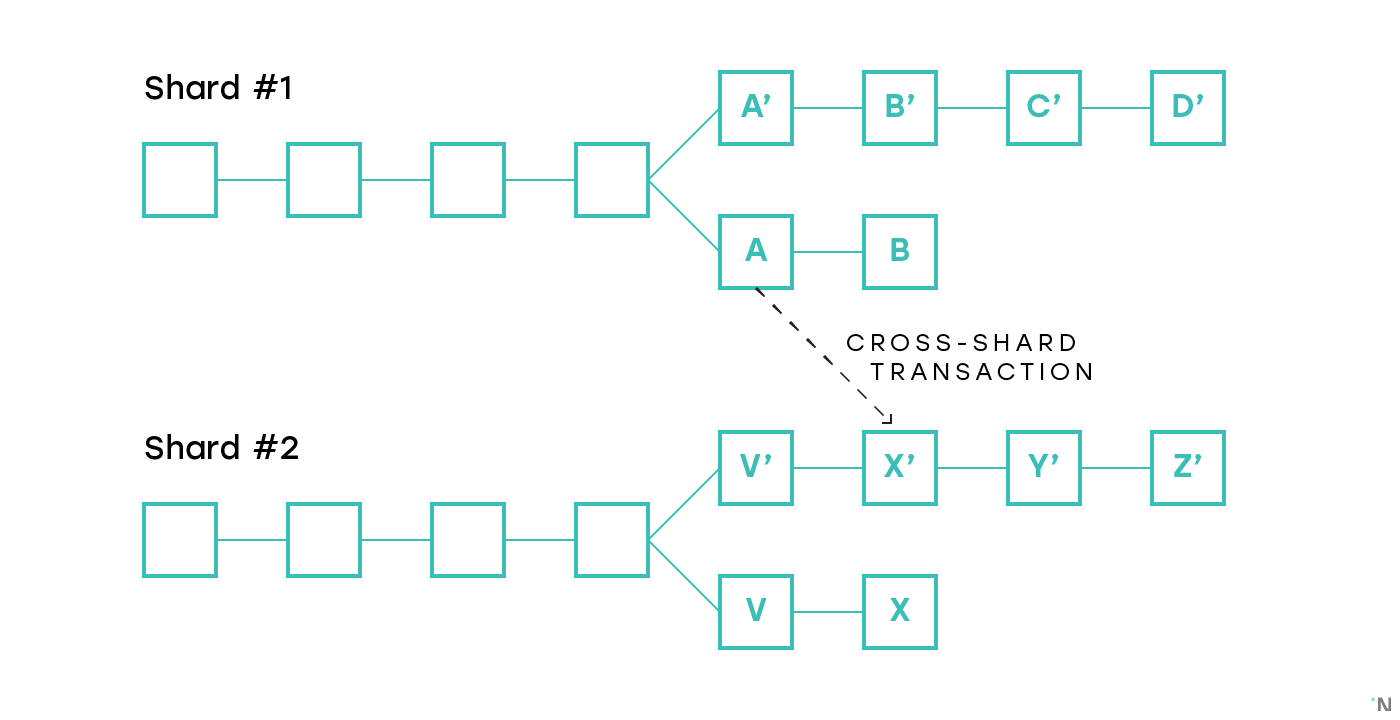
The Sharding idea is to make a blockchain more efficient by partitioning it into lighter units. These ‘pieces’ of blockchains are known as ‘Shards’. Each shard store different types of data and are independent of other shards. Sharding on ethereum will split the blockchain into 64shards. Consider these shards as interconnected units that consists a blockchain. Blockchain projects using the sharding technique are adopting different strategies to create a competent communication between the shards.

In terms of tokenomics, over two million ethereum have been burnt so far following the EIP-1559 which proposed to burn a portion of every transaction fee paid by users. With this, ethereum is automatically deflationary and supply is in constant reduction.

It’s exciting, what’s set to come to ethereum blockchain in the near future. Controlled by a team which has shown competence over the years; these new features are sure to be a game changer for ethereum and cryptocurrency as a whole. The effect of these on the price will surely be determined by the market, which is a tool on its own. Regardless, it’s all starting to look good for the smart contract blockchain.


Read More